How Agility Robotics uses artificial intelligence, from their humanoid 'Digit' to everyday workflow
Published in Business News
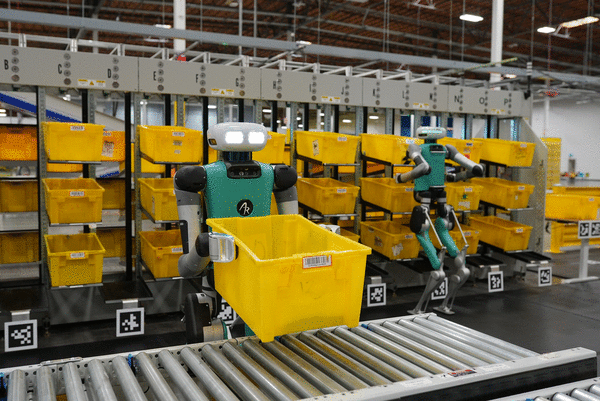
Digit the humanoid robot is 5 feet 9 inches tall and lives in warehouses, helping its human coworkers move and stack boxes up to 35 pounds. It also "smiles" and waves.
Robots like Digit are a growing pursuit among robotics companies that are trying to bring humanoids into everyday life, and specifically into the home as helpers. A crucial part of that equation is using artificial intelligence to help the robot observe, interpret and respond to its surroundings in real time, without human intervention.
But your dishwasher is also a robot and one that works quite well, said Pras Velagapudi, chief technology officer at Agility Robotics, the maker of Digit. And, most important, it's proven safe in the home.
While humanoid robots may not be folding your laundry and doing your dishes anytime soon, companies including Salem, Ore.-based Agility have a long-term goal to put robots wherever they can be in the world.
"We want to be producing a humanoid robot that can solve all of those disparate types of labor problems that are out there in the world," Mr. Velagapudi said. "We would love to have Digit take on all of the manual labor that people don't want to."
But Digit, for now, is for industrial use.
"We just have a plan to get there that involves starting with the most obvious, short-term places where we can put Digit right now," he said.
Velagapudi has worked with many different robots across two decades including 10 years at Carnegie Mellon University. For him, one observation has held true.
"Robots have to serve purposes," he said. "They can't just exist in the world for the sake of existing in the world. They have to be able to do useful work to prove themselves, at least at scale."
Although Agility builds humanoids — which are an "extremely powerful" form — he warned against the notion that human-shaped is the only, or best, kind of robot configuration.
"There's great robot arms that are welding cars together. There's conveyance systems that can store and retrieve boxes," Velagapudi said. "Your dishwasher is a robot. It works great. You wouldn't necessarily want to replace your dishwasher with a humanoid standing over the sink."
Currently, Digit is working with Amazon to help move products in warehouses. On Wednesday, Agility announced a partnership with Mercado Libre, "the leading company in e-commerce and financial technology in Latin America" headquartered in Montevideo, Uruguay. Digit will help with fulfillment operations at Mercado Libre's facility in San Antonio.
Employing AI
Robotics and artificial intelligence grew up together, often informing each other's growth. Today, AI is helping accelerate robotics, and robotics gives AI a "body" to experience the world.
But that began in the 1960s with Shakey the Robot, "the first mobile robot with the ability to perceive and reason about its surroundings," according to its genesis institution, the Stanford Research Institute. Shakey had a camera and optical rangefinder to "see," as well as bump detectors, a radio antenna and push bars to move things.
"Historically, a lot of robotics techniques are AI techniques. They're indistinguishable," Velagapudi said. "They were the same things from day one."
"More recently — and when I'm talking more recently, I mean decades — AI's become its own thing as it's been adapted to serve these different needs outside of just the robotics and pure computer science space."
That more "modern" AI, he said, is crucial to Digit — for operating controls, learning skills, keeping balance, perceiving objects in the world, "areas where the robot can't necessarily be completely exactly told what the answer is," he said.
You can't write an equation for everything, he said.
Agility's team also uses AI, such as Google and Nvidia products, in their everyday workflows, "like any fast-paced business out there right now," Velagapudi said. The tools have gotten "quite good and quite affordable" he said, and AI acts as a huge multiplier to the team, helping offload documentation and program management.
AI also augments Agility's coding process as a kind of "coach," which is significant given that half of the engineering team is in software development, while the other is in hardware.
But ultimately, he said the engineers are fully responsible for the code they write, whether they choose to use AI or not.
Safety in future human-robot coexistence
Digit was a hit at the Pittsburgh Robotics Network's Robotics and AI Discovery Day, which was held at the David L. Lawrence Convention Center in November.
A blue and silver humanoid, Digit garnered much attention at the convention in the "Robotics" zone, where people fawned over the bot. Digit smiled back with its pixelated eyes, and waved at its audience. But Digit was still kept behind crowd-control stanchions, away from direct contact with visitors.
Although robots far more dangerous than humanoids have been a part of manufacturing and industry for some time now, the safety around humanoids is a new, developing science — and a "much, much, much harder challenge that AI on its own doesn't immediately solve," Velagapudi said. It will be some time before humanoids are proven safe in the home.
"How do you add something that is potentially hazardous into your environment safely? That's why I think we can see adoption of humanoids in those sectors, in warehouse and logistics and manufacturing, because we've kind of started that work way back in the '60s when the first robot arms were coming into the space," he said.
But the fact that humanoid robots can enter the world around them without necessarily changing its infrastructure is an exciting new frontier, he said.
"My favorite part about all of this is we're truly at a point where we can build machines that go out in the world and affect it in ways that are very similar, on par, to what humans can do. That's so exciting," Velagapudi said.
"That's never been the case before. It's never been the case that you could take a robot out into the world and easily have it do something like play cornhole, or move around the same objects that you move around without having to modify the environment, without having to put rails on it or put special tags on it."
_____
©2025 PG Publishing Co. Visit at post-gazette.com. Distributed by Tribune Content Agency, LLC.










Comments