California, other states sue Trump for blocking EV charging funds
Published in Business News
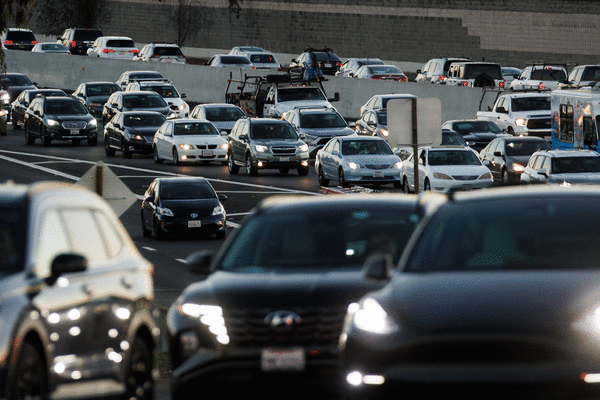
California led a coalition of 16 states Tuesday to sue the Trump administration in an effort to free up billions of dollars in federal funds intended to build and repair electric vehicle charging stations that it argues the White House has illegally blocked.
Attorney General Rob Bonta said the U.S. Department of Transportation did not have the authority to suspend $180 million to fund EV charging programs in California which Congress and former President Biden had already approved in 2021 as part of the landmark Bipartisan Infrastructure Act.
“This is funding that was lawfully directed to states and local communities by Congress,” Bonta said at a news conference.
“Trump is putting the brakes on projects that would reduce planet-warming pollution and smog, expand access to clean vehicles and create thousands of green jobs,” he added.
The 2022 law provided $63 million to Caltrans to repair broken EV chargers around the state; $55.9 million for zero-emission projects at major ports like Oakland and Los Angeles; and $59.3 million to Caltrans to build chargers for electric trucks, delivery vehicles and buses.
California has more electric vehicles than any other state.
Last year in California, 25.3% of the new vehicles sold were electric, according to the California Energy Commission.
In some counties, the number is even higher.
In Santa Clara County, 43.8% of new passenger vehicles purchased last year were “zero emission” — basically electric or plug-in hybrid. In Marin County, it was 40.1%; Alameda County 37.7%; Contra Costa County 32.7%; San Mateo County 25.3% and San Francisco 35.6%. It was 31% in Orange County, and 26.5% in Los Angeles County.
The top-selling car in California for the past three years has been the Tesla Model Y, according to data from the California New Car Dealers Association, surpassing the Honda Civic, Toyota Corolla and other traditional gasoline-powered vehicles that once led sales.
To continue to expand EVs to reduce smog and greenhouse gas emissions, however, and hit goals for electric buses, trucks, and delivery vehicles, California and other states need more public chargers and funding to help repair chargers that are broken.
On the day Trump took office in January, he issued an executive order called “Unleashing American Energy.” It told all federal agencies to expand offshore oil and gas drilling, speed construction of oil and gas pipelines, streamline mining regulations, and drop greenhouse gas regulations. The order required agencies to “immediately pause” disbursing money to electric vehicle charging programs under laws previously signed by President Biden.
The Department of Transportation did not respond Tuesday when asked about the lawsuit.
In June, California and other states won a federal court ruling in a similar case in Seattle. In that case, they sued claiming that the Trump administration’s withholding $5 billion in other electric vehicle charging funds approved during the Biden administration also was illegal and a federal district judge agreed. The administration relented, and has begun distributing the money.
At that time, the Department of Transportation issued a statement saying: “Another day, another liberal judicial activist making nonsensical rulings from the bench because they hate President Trump.”
Altogether, Tuesday’s lawsuit affects $2.5 billion nationwide in EV charging funds that were provided under the 2021 law and which the Trump administration has not released.
The EV charging programs have been cited as an example of how the Biden administration’s broad ambitions were hamstrung at times by slow federal bureaucracy and red tape. Although the money became available in 2022, much of it had not been distributed by the time Biden left office in January 2025 because the administration was slow to set standards for states to apply, and requirements like “made in America” mandates and complex contracting rules.
The action is California’s 50th lawsuit against Trump in the 47 weeks he has been in office. The others cover a wide range of topics, from his imposing tariffs on foreign goods, to sending the National Guard to Los Angeles to enforce immigration rules to his rule charging employers $100,000 for each H-1B visa they request. Bonta said so far California has won 80% of them.
It is also the latest battle between California and other Democratic states pushing back against the Trump administration’s attempts to limit the spread of electric vehicles.
This year, Trump and Republicans in Congress ended the $7,500 federal EV tax credit. They allowed a program to expire that permitted EVs to drive solo in carpool lanes. And they passed legislation blocking a California law that prohibits the sale of new gasoline-powered passenger vehicles statewide starting in 2035. Bonta sued over that issue. Trump also has issued plans to open the entire West Coast to new offshore oil drilling.
“It’s clear that Trump’s promises to his big oil donors have clouded his judgement yet again,” Bonta said.
On Tuesday, Colorado Attorney General Phil Weiser said the latest case raises fundamental issues about the Constitution’s balance of powers.
“The president does not have the power of the purse,” he said. “Congress mandates funds, like it did here. If the president doesn’t spend the funds, that’s illegal.”
Weiser said there are hundreds of charging stations in projects totaling about $20 million in Boulder County, Pueblo County, and other parts of Colorado that were approved for the federal funds and which now are held “in never never land” with the Trump administration refusing to release the money or say why.
“I wish we lived in a world where the president was following the law,” he said. “But we’re not. This president seems to act as if he thinks he is above the law. He’s not. That’s why we have to file this lawsuit.”
In addition to Colorado and California, the other states joining Tuesday’s lawsuit were Arizona, Delaware, Illinois, Maryland, Massachusetts, Michigan, New Jersey, New York, Oregon, Pennsylvania, Rhode Island, Vermont, and Wisconsin, along with the District of Columbia.
©#YR@ MediaNews Group, Inc. Visit at mercurynews.com. Distributed by Tribune Content Agency, LLC.


Comments